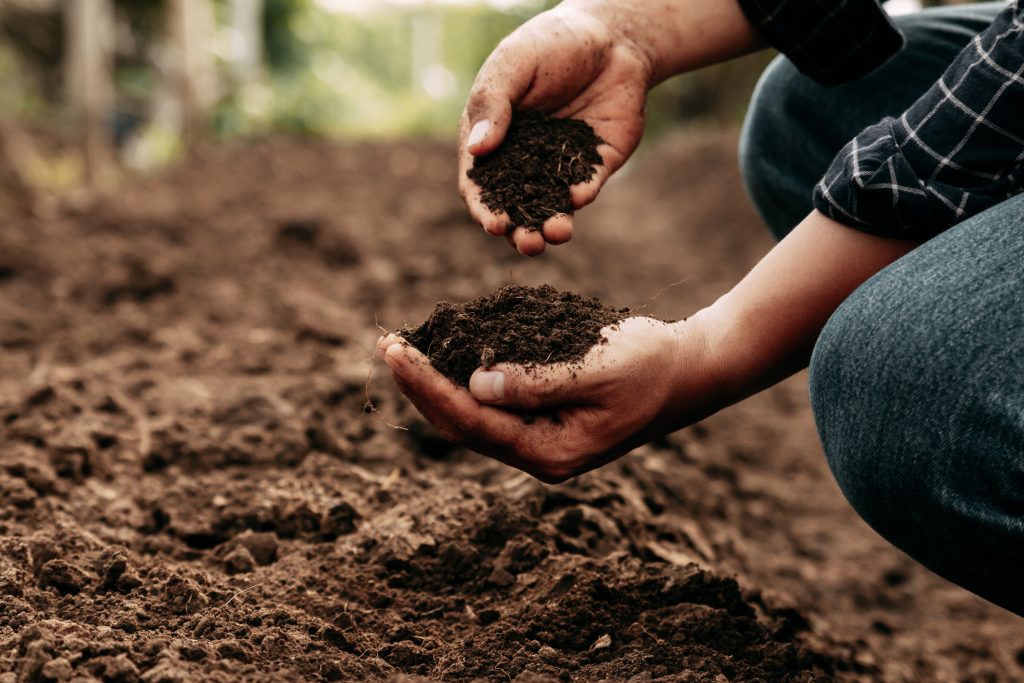
When I was a student of horticulture at university, I had to take an entire class on just soil with the heaviest textbook of all my classes. It was then I realized just how important soil is to gardening and how complex it is. While you don’t have to have a degree to be a great gardener, it should be your goal to manage the soil in such a way as to be most favorable for beautiful plants.
Why Soil Is More Than Just Dirt
According to soil scientist Dr. Greg Butters, soil is a multiphase, evolutionary body comprised of both inorganic and organic constituents that is the product of its parent material and the environmental conditions under which it develops. That’s just a fancy way of saying it’s more than just dirt! Here in Connecticut, it’s the legacy of glacial movements and the glacial till left behind. As every Connecticut gardener knows, this means lots of rocks!
Getting acquainted with your soil means understanding soil texture. Soil texture describes the percentages of sand, silt, and clay. To further break it down:
- Sand: The big guys at 2 – 0.05 mm that water runs through like a colander
- Silt: The middle child at 0.05 – 0.002 mm that performs the balancing act
- Clay: Tiny but mighty at < 0.002 mm that holds nutrients and water but can be clingy
What Sand, Silt, and Clay Mean for Your Garden
This may not seem very important or highly interesting, but the proportions of these particles affect the behavior of your soil. You can discover your soil’s texture by doing a soil test through the UCONN Soil Nutrient Analysis Laboratory or performing the DIY jar test.
Instructions for the jar test are here
Once you’ve uncovered your soil texture, check out the table to see how your soil behaves.
It is said when the Connecticut glaciers melted, the waters carried off smaller particles leaving behind sand. This is true for my garden and most gardens in Connecticut. Looking at the table, this means our soil:
- Can’t hold a lot of water (less water for our plants)
- Drains water fast (sometimes too fast)
- Doesn’t store nutrients well (drains with the water)
- Has low levels of organic matter (less food for our plants)
- Organic matter quickly decomposes (adds nutrients rapidly, only to be drained)
With these soil traits, there are some habits you can perform to keep your garden in excellent shape:
- Be vigilant of potential water stress in between water events
- Provide a frequent supply of nutrients to the soil
- Organic matter is key, such as compost, manure, or mulching
I can’t stress enough the importance of organic matter. Not only does it add a steady supply of slow releasing nutrients, but it’s also great for soil structure, water retention, and supports the microorganisms vital to healthy, life-giving soil. So, get to know your soil, the lifeblood of your garden, and reap the benefits with happy, healthy plants!
GENERALIZED INFLUENCE OF SOIL SEPARATES ON SOME PROPERTIES AND BEHAVIOR OF SOILS